
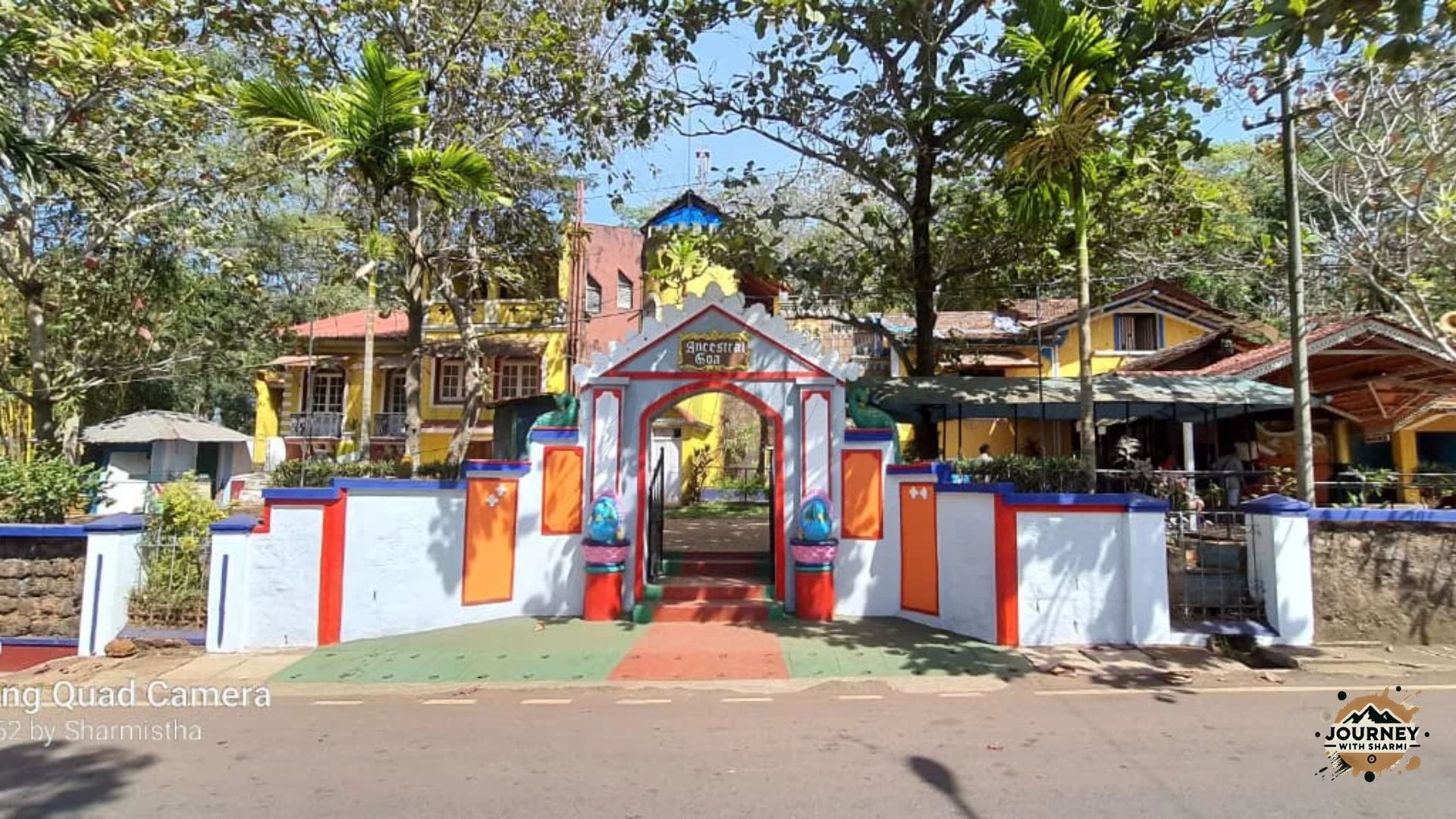
Big Foot Museum Goa: Skip the Nightlife for 100-Year-Old Village Life on a 9-Acre Ancestral Estate
During our South Goa trip, setting aside time to explore museums in Goa led me and my husband straight to the gates of the Big Foot Museum. And honestly, you won’t believe it—we had no idea that we were about to spend nearly half our day completely absorbed in another era.
Sometimes, the best travel memories aren’t the ones we meticulously plan for—they’re the quiet surprises waiting just down a leafy village road. And let’s be honest, we all love a good surprise, whether it’s an unexpected gift or stumbling upon a hidden gem while travelling.
The moment we stepped inside the Big Foot Museum, we realised this museum was nothing like those quiet, glass-cased galleries where you’re afraid to breathe too loudly. Spread across approx nine lush, open-air acres, this rural heritage museum breathed with genuine warmth and life.
Local artist and researcher Maendra Jocelino Araujo Alvares single-handedly conceptualised, sculpted, and built this entire space. Walking past the life-sized village huts and handcrafted scenes felt deeply personal — almost as if the red Goan soil beneath my feet was whispering stories of the generations that came before me.
Here, I’m sharing everything from my personal visit to the Big Foot Museum (Ancestral Goa)—including its entry tickets, timings, hidden zones, local legends, and practical tips so you can plan your visit effortlessly.
Big Foot Museum in Goa: A Quick Visitor Guide That You Must Note Before Visit
Officially named Ancestral Goa—though almost everyone knows it as the Big Foot Museum—this hidden gem easily ranks among the best places to visit in Goa. Here is everything you need to know at a glance before planning your trip:
- Address: Near Saviour of the World Church, Loutolim, Salcete Taluka, South Goa (Google Map)
- Big Foot Museum Opening Hours: It is usually from 9:00 AM to 6:00 PM every day. (Still, I’ll recommend calling their office once before your visit if there are any changes).
- Big Foot Museum Entry Fee: INR 150 per person; You need to pay an extra INR 20 if using the still camera
- Time Required to Explore: At least 1.5 to 2 hours is needed to complete it properly.
- Guided / Audio Tour: It is included with the entry ticket; the language is available in English, Hindi, and Konkani, but a person from the museum will be with you to guide you and answer your questions if you’ve.
Inside Big Foot Museum: How Goa’s Ancestral History Is Showcased Here To Us
We were struck by how the Big Foot Museum is dedicated to preserving and celebrating Goa’s rich art, culture, architecture, and environment. This privately owned, open-air estate offers an authentic glimpse into rural Goan life as it existed over a century ago. Through life-size sculptures, traditional architecture, and lush plantations, every corner brings the state’s everyday rhythms, social customs, and enduring heritage to life in a vibrant and educational way.
Before starting our journey inside, we purchased our tickets at the counter, where the staff asked for our preferred language—English, Hindi, or Konkani—to configure the automated audio guide across the estate. We chose English. Even though the narration system is automated, a kind young guide walked us to the starting path to ensure our visit went smoothly. Stepping out onto the shaded trails, we quickly realised how essential the narration was; as we walked past each exhibit, sensor-triggered speakers. It is entirely supported by detailed informational plaques—sharing the rich folklore, social customs, and traditional craft techniques woven into every scene.
1. The Statue of Lord Parashurama
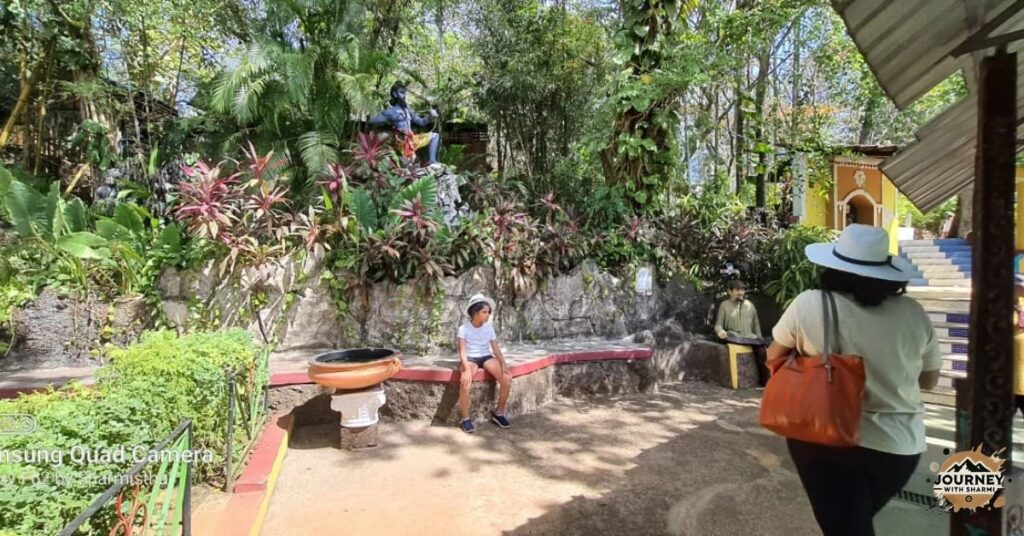
Just outside the reception area, the first major landmark to greet us was a towering statue of Lord Parashurama. According to regional mythology, he shot an arrow into the Arabian Sea to reclaim the Konkan coast, creating the land of Gomantak, or ancient Goa. Beginning the walk here anchors the entire museum experience in Goa’s origin story.
2. A Fishermen’s Land & Traditional Village Occupations
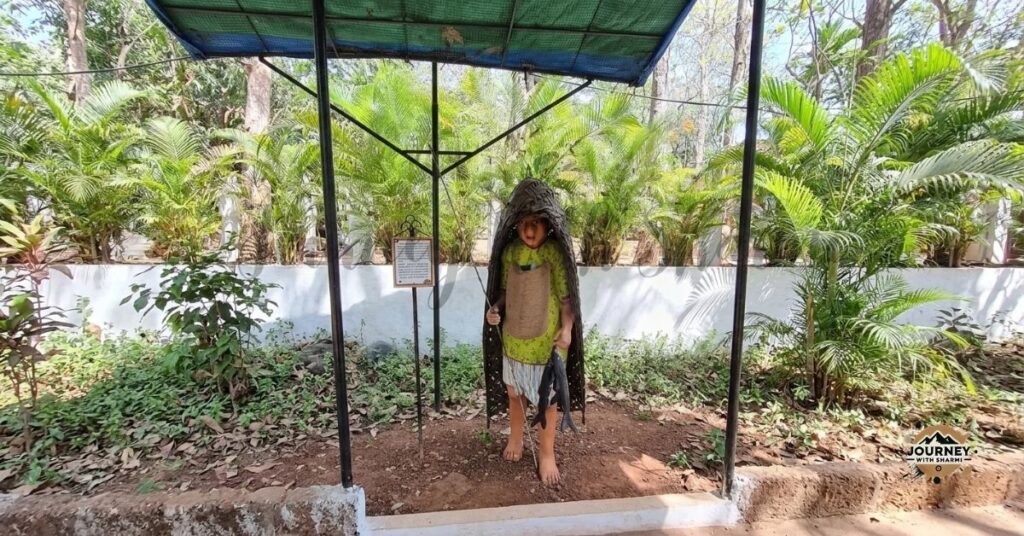
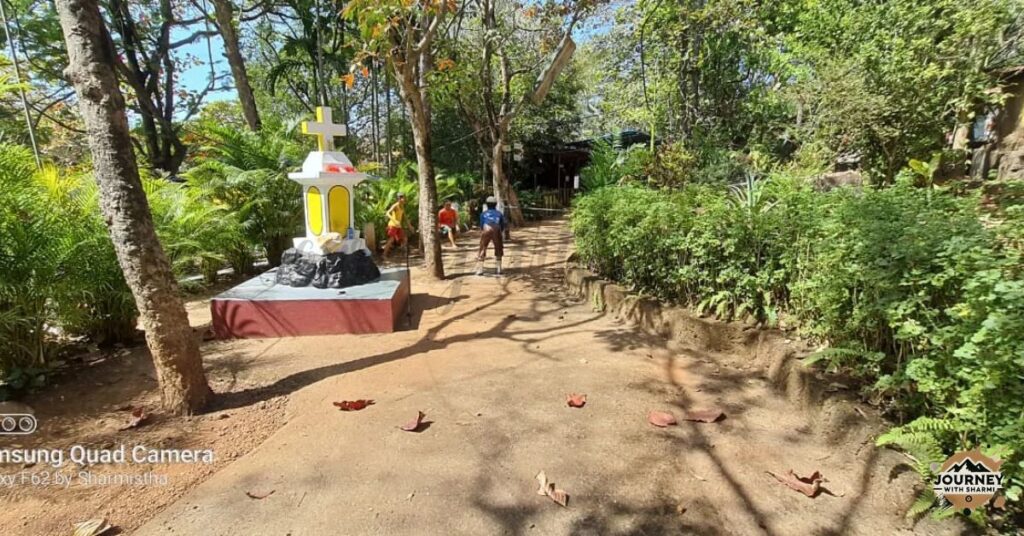
Moving deeper along the winding laterite trails, we walked through a life-size recreation of a 19th- and early 20th-century Goan village. Fishing has always been—and still is—the heart of Goa’s economy. The displays of wooden boats, woven nets, and bamboo traps (koblem) are so finely detailed that walking past them feels like stepping back in time.
What captured our imagination most, however, were the scenes of fishermen (Kharvi) unwinding at home with local music and a hookah, vividly portraying their joyful way of life both at sea and onshore.
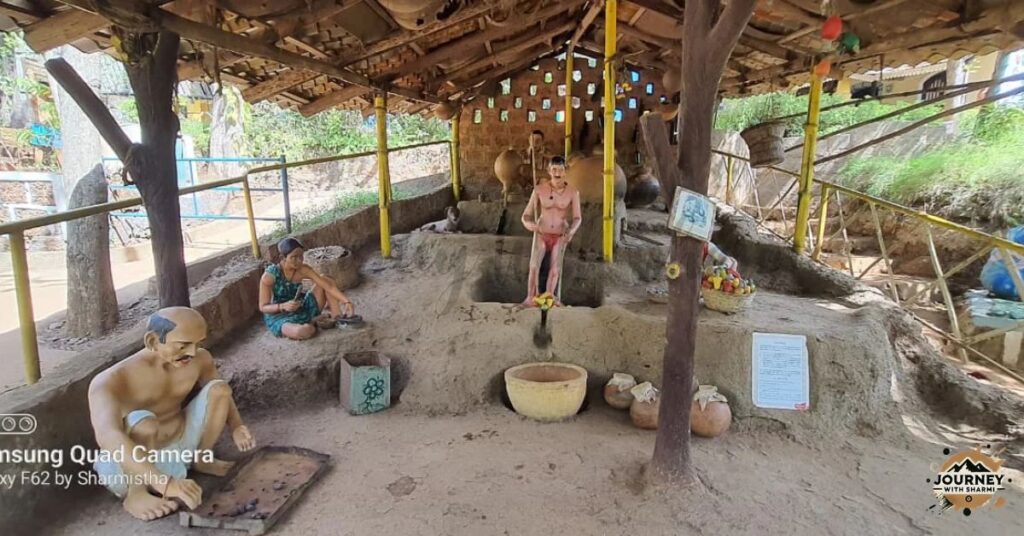
Around the village, detailed fibreglass and laterite sculptures stage the daily social and economic routines of rural life:
- The Village Taverna & Market Square: A lively recreation of a neighbourhood tavern and market where locals gathered after work to drink feni, play cards, trade produce, and exchange village news.
- Cashew Feni Distillation Unit (Bhatti): A detailed setup illustrating the traditional method of fermenting crushed cashew apples and distilling the juice using clay pots, copper condensers, and firewood furnaces to produce urrak and feni.
- The Toddy Tapper (Render): One of the most striking figures in the complex—depicting a tapper scaling a tall coconut palm with a coir loop around his ankles and a clay gourd (dudhi) tied at his waist to collect fresh palm sap for vinegar, toddy, and jaggery.
- The Baker (Poder): Representing the iconic Goan village baker delivering fresh poi and undo bread from a bamboo basket strapped to a bicycle, complete with his signature brass horn.
- The Potter (Kumhar), Blacksmith (Lohar) & Carpenter (Sutar): Workshops showing artisans shaping clay matkas (water pots) and roof tiles on a stone wheel, forging iron agricultural tools, and hand-carving wooden furniture.
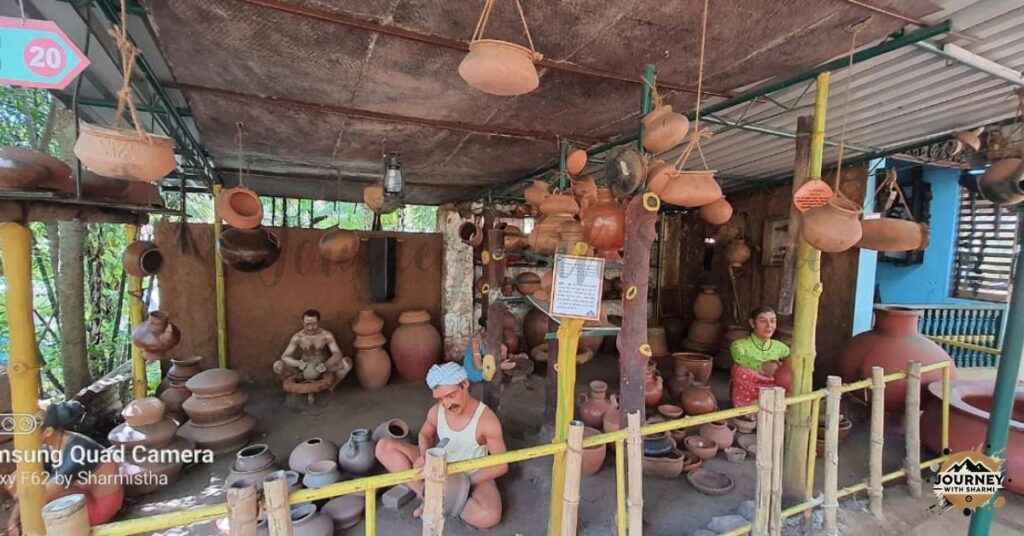
- Coconut Peelers & Farmers (Kunbi): Scenes depicting coconut husking spikes, spice and paddy harvesting, and rare, traditional farming tools that highlight the region’s deep agrarian roots.
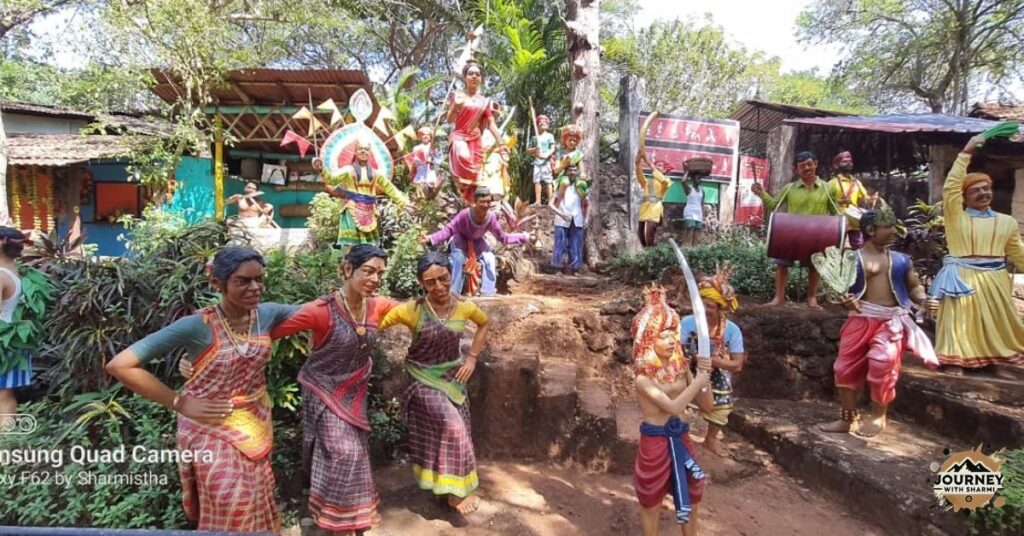
- Escola da Musica & Folk Performers: A dedicated music school corner and statues of village musicians playing the ghumat (Goa’s traditional earthen percussion instrument), madel, and shamel, alongside depictions of traditional Goan folk dances.
3. The Land of Cows, The Gow Kund & Forgotten Attire
The name ‘Goa’ itself is derived from the Sanskrit word ‘gow‘, meaning ‘cow’. Historically, cattle were deeply revered in the region, and dairy farming was central to rural livelihoods. In ancient Goa, natural and man-made water sources were often adorned with carved cow heads, creating the sacred impression that water flowed directly from the cow’s mouth (Gow Kund).
At the museum, a tranquil artificial lake brings this tradition to life. Watching the sculpted scenes of mothers gracefully carrying water in earthen pots while children dive joyfully into the pond was one of the most enchanting moments of my visit. Stepping through these displays felt like opening a living time capsule of a quieter era, when coastal villages moved with the rhythm of the tides.
While modern visitors often picture Goa in bright floral beachwear, the exhibits showcase the region’s true sartorial heritage: flower girls wearing vibrant ghaghras paired with floral blouses and colourful blossoms tucked into their hair, housewives draped in vivid nine-yard Nauvari sarees with checkered blouses, and the practical, iconic attire of traditional Goan fishermen.
4. The Sacred Cave & The Legend of the “Big Foot”
Further up the hillside path, we entered a quiet, cave-like shrine housing the centrepiece that gives the museum its popular name: a massive 1.4-metre-long footprint embedded directly into the natural laterite rock.
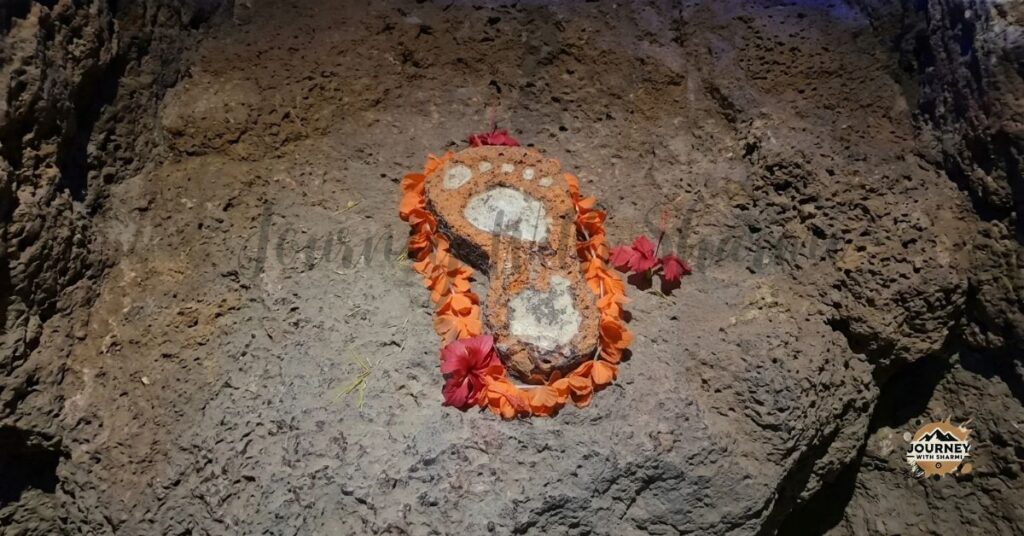
The audio narration said that the footprint belonged to Mahadar, a rich but very kind landowner who lived in the area hundreds of years ago. He shared his harvest and wealth freely with the poor until greedy villagers conspired to take advantage of his kindness, stripping him of everything he owned. Left homeless and penniless, Mahadar still harboured no bitterness. Moved by his pure spirit, the gods offered him a boon.
Refusing wealth or revenge, he asked only for a small spot where he could stand and pray in peace. He was granted a scorching rock where he stood on one foot in deep penance—leaving his giant footprint permanently pressed into the stone. Visitors traditionally touch the rock or offer a silent prayer for good fortune.
(Note: The complex also features the Big Foot Dance Floor, an open-air venue shaped like a giant footprint that hosts cultural folk performances, weddings, and community events.)
5. Sant Mirabai: India’s Longest Laterite Sculpture
Just beyond the Big Foot shrine, we stood before the museum’s most extraordinary artistic feat: a 14-metre-long (46-foot) horizontal sculpture of Sant Mirabai, the 16th-century Rajput princess and devotional poet.
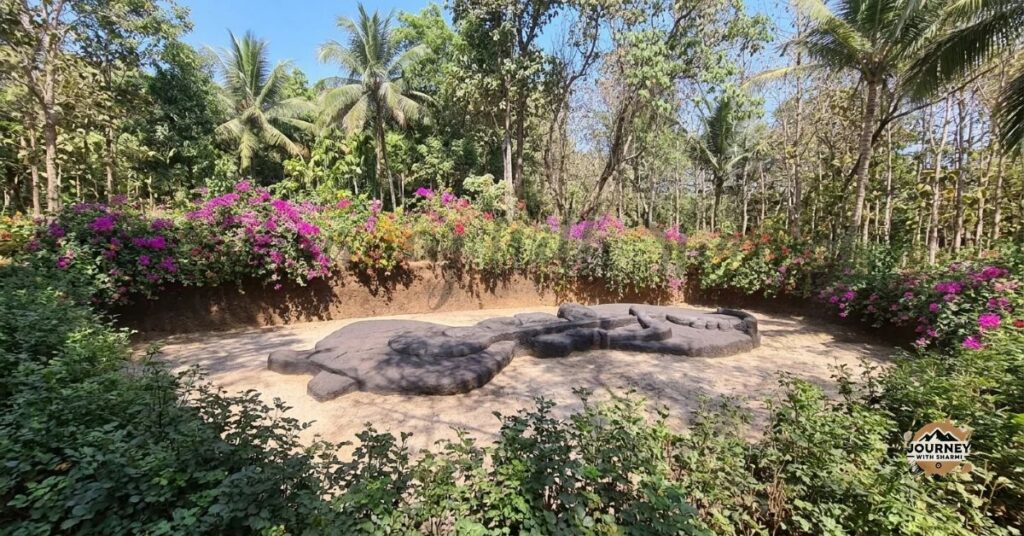
- The Material & Craft: Founder Maendra Alvares hand-carved the entire figure directly out of a single, massive monolith of natural laterite stone (chira)—the porous, iron-rich red rock native to Goa that hardens upon exposure to air.
- National Record: Completed in just 30 days, it holds a place in the Limca Book of Records as the longest laterite sculpture in India.
- Artistic Details: Mirabai is sculpted reclining peacefully with her ektara (single-stringed lute) resting beside her, adorned with a traditional kumkum on her forehead, armlets, and anklets. Looking closely at the chisel marks in the raw red laterite reveals the sheer physical scale of the work.
6. Traditional Goan Architecture & Casa Araujo Alvares
The museum contrasts the modest thatched-roof mud huts of rural workers (Mundkars) with the grandeur of elite Indo-Portuguese architecture. Right alongside the main complex stands Casa Araujo Alvares, a restored 400-year-old Indo-Portuguese mansion showcasing colonial-era Goan aristocratic life. Walking through the mansion, we observed:
- The Balcão (Porch): Built-in masonry seating flanking the front entrance where families greeted neighbours in the evening.
- Oyster-Shell Windows (Carepa): Traditional window panes fitted with translucent Placuna placenta (windowpane oyster) shells rather than glass, diffusing harsh sunlight into a soft, pearly glow.
- Period Interiors: Antique rosewood furniture, four-poster beds, porcelain collections, brass utensils, copper water boilers (bamb), and traditional stone grinders (rogdo and dantem). (Casa Araujo Alvares also hosts an optional sound and light show for around INR 100 per person.)
7. The Spice Plantation, Medicinal Garden & Eco-Zone
The nine-acre grounds double as a lush botanical, spice, and rubber plantation that serves as a habitat for local birds. Placards along the trail identify each plant’s culinary and Ayurvedic uses in traditional Goan households. Along the way, we spotted:
- Black pepper vines spiralling up tall areca nut palms
- Cardamom, cinnamon, nutmeg, and clove trees
- Star fruit (karambol), breadfruit (nirponos), kokum (bhirand), and jackfruit trees
- Native medicinal herbs and rubber trees
8. The Cross Museum, Art Gallery & Handicraft Centre
Before heading toward the exit, the path leads into three curated indoor spaces:
- The Cross Museum: A specialised collection housing hundreds of crosses from around the world, highlighting diverse regional styles, materials, and Christian iconography.
- Big Foot Art Gallery: An exhibition space displaying paintings, sculptures, and mixed-media works by Goan and national artists.
- Handicraft & Souvenir Shop: A retail centre stocked with authentic local Goan crafts—terracotta pottery, coconut-shell carvings, hand-painted azulejos (Portuguese-style ceramic tiles), local spices, and cashew feni.
9. Spring-Water Well & Big Foot Restaurant
Near the end of the trail sits a natural spring-water well framed by ferns, followed by the open-air Big Foot Restaurant, where we stopped for traditional Goan snacks, fresh lime soda, and local coastal dishes cooked with regional spices.
How We Reached Big Foot Museum
Located in the quiet village of Loutolim in South Goa (roughly 400 metres from the Saviour of the World Church), the museum sits conveniently between North and South Goa’s main transit hubs, making it easy to pair with Margao or Old Goa.
We stayed at the Railway Holiday Home near Madgaon Railway Station, which was roughly 7 to 10 km south of the museum—about a 15- to 20-minute drive via NH-66 and the Loutolim village road. (Note: Since the museum is north of Margao, your hotel in Margao is south of the museum).
If you’re travelling from other parts of Goa, here is how long it takes to reach the museum:
- From Dabolim Airport (GOI): Approximately 22 km away—about a 35- to 40-minute taxi ride.
- From Panaji (Panjim): Roughly 28 to 30 km south—around a 45- to 50-minute drive via the Zuari Bridge.
- Parking: A dedicated parking lot sits right outside the main entrance gate, with space for two-wheelers, cars, and tour buses.
Travel Tips For Your Visit To Big Foot Museum
- Best Time to Visit: I recommend visiting between October and February, when Goa’s weather is pleasant and offers the most comfortable conditions for walking the open-air trails. For the best experience, try to arrive between 9:30 AM and 11:30 AM to beat both the afternoon heat and the tour-bus crowds.
- Footwear & Clothing: Wear comfortable walking shoes or gripped sandals, light cotton clothes, and carry a reusable water bottle. The trail climbs and descends uneven laterite steps and gravel paths.
- Accessibility: Because the complex is carved into a natural hillside with multiple stone steps, it is not wheelchair accessible and may be strenuous for elderly visitors with mobility or knee issues.
- Photography: Mobile photography is free, while carrying a dedicated still camera incurs a nominal INR 20 fee at the ticket counter.
- Nearby Heritage Stops to Combine: Loutolim is packed with historic architecture—you can easily combine the Big Foot Museum with Figueiredo Mansion (a 400+ year-old heritage home nearby) and the Saviour of the World Church.
Summary From My Own Experience: Why the Big Foot Museum Deserves a Spot on Your Goa Itinerary
Most travellers visit Goa for its coastline, seafood, and laid-back beach towns, which means the state’s inland villages—and the centuries of indigenous culture rooted there—often go completely unnoticed. That is precisely why the Big Foot Museum stands out as such a rewarding stop.
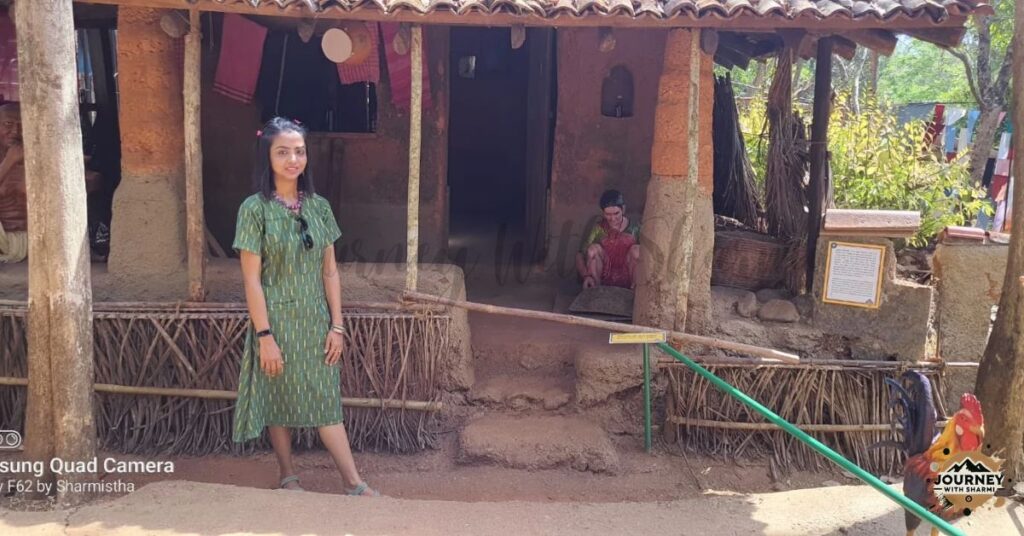
What makes it truly special isn’t just what it displays, but how it tells its story:
- It bridges the gap between tourist Goa and real Goa: The standard sightseeing shows you colonial churches and sandy shores, while this open-air space introduces you to the everyday labourers, artisans, farmers, and folk traditions that actually built Goan society.
- It feels personal rather than commercial: Knowing that the entire complex grew out of one local artist’s passion to preserve his homeland’s fading heritage gives the place a warmth and authenticity that big, state-run museums rarely achieve.
- It’s an effortless, sensory break: Walking beneath shaded spice trees, listening to local folklore, and seeing life-size village scenes makes history engaging for everyone—whether you’re travelling with curious kids, older parents, or just looking for a quiet morning away from the crowds.
If you want to leave Goa feeling like you actually understood the place—not just photographed its beaches—setting aside two hours for this hidden village sanctuary is one of the best choices you can make.
☛ Also Read:
- A Day In Sula Vineyards, Ultimate Gateway Beyond Nashik’s Ancient Sacred Soul
- Elephanta Caves, Mumbai: An Ancient Rock-Cut Temple, Secrets of Lord Shiva
- Dudhsagar Waterfalls Trek To The Top: Our Unforgettable Western Ghats Adventure
- My 22 Favourite Places to Visit in Mumbai, India
- Goa Chitra Museum, A Must Visit Museum To Explore Goa’s Agrarian History
- Mysore Palace, A Living Jewel Of Karnataka’s Royal Heritage
Frequently Asked Questions About Big Foot Museum Goa
Is the Big Foot Museum in Goa worth visiting?
Yes, this is one of the best places to visit in Goa, if you’re looking for some offbeat travel and want to explore Goa’s rural history, indigenous crafts, and folk traditions beyond its beaches and nightlife. Also, this museum is informative for families with children, cultural travellers, and photographers.
Will I get bored if I’m not usually a “museum person”?
You won’t get bored at all, because this museum is an open-air, walk-through village surrounded by greenery instead of rooms filled with glass cases and long text plaques; it feels much more like a relaxing nature walk combined with live storytelling. The automated audio brings the scenes to life, keeping the pace engaging even for kids and casual travellers.
Are guided tours available at the Big Foot Museum?
Yes, in this museum you can use the included automated audio guide (available in English, Hindi, and Konkani) or join an in-house guided walkthrough explaining the stories behind each exhibit.
Why is it called the Big Foot Museum?
The name comes from a 1.4-metre-long footprint naturally embedded in a laterite rock inside a cave shrine on the property, tied to the local folklore of a generous landowner named Mahadar, as well as the complex’s giant foot-shaped open-air dance floor.
Is it okay to visit during the afternoon, or does it get too hot?
Since almost the entire trail is outdoors, visiting between 12:30 PM and 3:30 PM can feel warm and humid—especially between March and May. While the tall spice and rubber trees offer good shade along parts of the path, arriving in the morning (before 11:30 AM) or after 4:00 PM makes walking the hillside steps much more comfortable.
Are there clean restrooms and food options available inside?
Yes. Basic, clean washrooms are available on the premises, and there is an open-air restaurant near the end of the trail where you can sit down for fresh lime soda, tea, light snacks, or a simple Goan meal after your walk.
Will I easily get a taxi or cab back to my hotel from Loutolim?
Because Loutolim is a quiet inland village rather than a busy beach hub, you won’t find cabs or auto-rickshaws waiting outside the gate, and app-based rides can be unreliable. If you are taking a taxi, it is best to book a round-trip cab and have your driver wait in the parking lot for 1.5 to 2 hours while you explore.
Is the entry ticket all-inclusive, or are there hidden charges inside?
Your main ticket covers the open-air village, the audio guide, the Big Foot shrine, the Mirabai sculpture, the spice garden, and the Cross Museum. The only optional extra costs inside are a nominal INR 20 fee if you carry a dedicated still camera, and a separate ticket (around INR 100) if you choose to tour the adjacent Casa Araujo Alvares heritage mansion.
Can senior citizens or toddlers comfortably manage the walk?
Toddlers and young children usually love the life-size statues and open trails, though strollers cannot be used on the uneven laterite paths. For senior citizens or anyone with knee pain, the hillside terrain has several stone steps and gentle inclines—taking it slow with breaks on the shaded benches works well, though visitors with severe mobility issues may find parts of the climb tiring.
Is this a good half-day trip to combine with nearby places?
Yes, it pairs easily with other South Goa spots. Since the tour takes about two hours, you can comfortably combine a morning visit here with a stop at the nearby Figueiredo Heritage Mansion in Loutolim, followed by lunch in Margao or a relaxed afternoon at Colva or Benaulim Beach (about 25–30 minutes away).